Meet our photoreactor with double-capacity: The EvoluChem PhotoRedOx Duo™. It’s the choice for the chemist who seeks higher reaction capacity and increased light intensity than found in the PhotoRedOx Box™. 본문
Meet our photoreactor with double-capacity: The EvoluChem PhotoRedOx Duo™. It’s the choice for the chemist who seeks higher reaction capacity and increased light intensity than found in the PhotoRedOx Box™.
켐코코리아 2026. 8. 3. 09:00
The Glorius group at the University of Münster reports a visible-light energy-transfer method for the chemoselective partial saturation of 2-pyridones and their derivatives – a substrate class previously inaccessible to mild photocatalytic dearomatization. The method runs at room temperature under 405 nm irradiation, tolerates halogens and a wide range of functional groups, and scales directly to gram scale in the EvoluChem PhotoRedOx Box Duo.
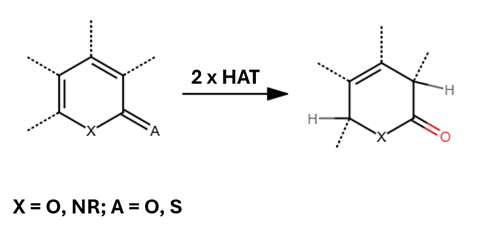
The Birch reduction is one of synthetic chemistry’s most powerful tools for building partially saturated (hetero)arenes – the sp3-enriched scaffolds that populate the structural cores of drug candidates and natural products. But the classic conditions (alkali metals dissolved in liquid ammonia, −78 °C) impose a high practical cost: pyrophoric reagents, cryogenic equipment, and conditions so reducing that halogens, esters, and other common functional groups are collateral damage. Energy-transfer (EnT) photocatalysis has already opened milder routes to Birch-type products from bicyclic (hetero)arenes such as quinolines and naphthalenes. The monocyclic case – and specifically 2-pyridones, the 14th most common nitrogen heterocycle in FDA-approved small-molecule drugs – has remained out of reach. A new paper from Frank Glorius’s group at the University of Münster solves this problem.
“Energy-Transfer Catalysis Enables the Birch-Type Reduction of 2-Pyridones”
P. Hartmann, S. Liljenberg, J. Domack, N. Hölter, C. Daniliuc, F. Glorius | Angew. Chem. Int. Ed. 2026, e9565676
The challenge: why monocyclic 2-pyridones are hard
Energy-transfer catalysis works by exciting a photosensitizer to its triplet state, which then transfers energy to the substrate and populates its own triplet state – from which radical chemistry can proceed. The challenge with monocyclic heteroarenes is energetic: their triplet excited states sit at around 60–80 kcal/mol, which approaches or exceeds the upper limit of what visible-light sensitizers can deliver. Bicyclic systems like quinoline (ET ≈ 60 kcal/mol) have been made to work with carefully chosen sensitizers. 2-Pyridones sit at approximately 60 kcal/mol as well – right at the frontier of what’s accessible.
Photoredox approaches are an alternative, but they rely on strongly oxidizing or reducing excited-state catalysts that compromise functional group tolerance – the very problem the Glorius group set out to circumvent. In drug discovery, where substrates routinely carry halogens, esters, amines, and other reactive handles, chemoselectivity is as important as reactivity.
The solution: thioxanthone sensitizer and a HAT donor
The Glorius group’s design exploits thioxanthone (TXT) as the photosensitizer. TXT has a triplet energy of 65.5 kcal/mol – just enough above the 2-pyridone triplet energy (~60 kcal/mol) to make energy transfer exergonic – while avoiding the strongly oxidizing or reducing excited-state chemistry of Ir or Ru photoredox catalysts. Critically, TXT absorbs at 405 nm, aligning directly with the output of the EvoluChem 405 nm LED.
The second component is p-methoxyphenyl thiol (p-MeO-PhSH, 5a), which serves as the hydrogen atom donor. After EnT populates the triplet state of the 2-pyridone, two successive hydrogen atom transfer (HAT) steps from the thiol deliver two hydrogen atoms to the substrate, converting the aromatic ring to a partially saturated dihydropyridone. The resulting thiyl radicals recombine to give disulfide (thermodynamically favorable, ΔG = −30.2 kcal/mol), making the overall transformation irreversible and driving it to completion.
Standard conditions: TXT (5 mol%), p-MeO-PhSH (4.0 equiv.), MeCN (0.1 M), argon, room temperature, 19 h
Light source: EvoluChem™ HCK1012-02-012 LEDs (18 W, λmax = 405 nm) ×2
Photoreactor: EvoluChem™ PhotoRedOx Box Duo (HepatoChem)
Major product: 3,6-dihydropyridone (regioisomeric ratio 90:10)
Model yield: 82% (2aa:2ab = 90:10) by 1H NMR
Mechanism: EnT followed by two HAT steps
The mechanistic picture was established by a combination of experimental and computational studies. Control experiments confirmed that both photocatalyst and light are essential – no product forms without either. Radical trapping with BHT (2,6-di-tert-butyl-4-methylphenol) intercepted the allylic radical intermediate and suppressed product formation, confirming a radical pathway. UV–Vis absorption spectroscopy showed that TXT is the exclusive absorbing species at 405 nm – no EDA complex between substrate and thiol was detected. Stern–Volmer luminescence quenching experiments demonstrated that TXT emission is quenched efficiently by the 2-pyridone but only weakly by the thiol, confirming that EnT to the substrate is the primary quenching pathway. Cyclic voltammetry ruled out a single-electron transfer (SET) pathway, as 2-pyridone 1a shows no reduction or oxidation wave in the accessible redox window of excited TXT.
DFT calculations (M06-2X/def2-QZVPPD) mapped the full reaction network and rationalized the observed regioselectivity. EnT from ³TXT* to ground-state ¹1a is exergonic, populating triplet ³1a with Mulliken spin density concentrated at C3 and C6. The first HAT step from the thiol preferentially occurs at C3 or C6 (Int-A, kinetically favored by ΔΔG‡ = 1.4 kcal/mol over C4/C5). From Int-A, the second HAT proceeds under kinetic control to give the observed major 3,6-dihydropyridone product – which contains an isolated double bond and is not the thermodynamically most stable regioisomer. The minor 3,4-isomer arises from the accessible alternative Int-B pathway.
Substrate scope: broad functional group tolerance and exceptional chemoselectivity
With optimized conditions in hand, the Glorius group explored the scope across 40+ examples. Several features stand out.
Halogen tolerance. Fluoro (2c, 48%), chloro (2d, 53%), bromo (2e, 53%), and nitrile (2f, 51%) substituents at C5 all survived the reaction conditions intact. Under classical Birch conditions, aryl chlorides and bromides are reduced to give dehalogenated products. The ability to carry halogens through the reaction without loss is practically significant for drug synthesis, where C–X bonds are retained for downstream cross-coupling steps.
Diverse functional groups tolerated. Esters (2h, 65%), Weinreb amides (2k, 60%), alkynes (2i, 50%), and a geraniol ester (2l, 65%) were all compatible. Terminal alkenes and alkynes remained intact under the radical conditions without competing thiol-ene or disulfide-ene reactivity. Aldehydes were not tolerated (thioacetal formation), and nitro groups and benzoate-protected pyridones were incompatible. Free carboxylic acids completely suppressed the reaction.
N-substitution. Methyl (2m, 65%), hydroxyethyl (2n, 55%), Boc (2o, 60%), aryl groups including phenyl (2t, 60%) and p-methoxyphenyl (2u, 75%), ketones (2w, 57%), and phenols (2y, 69%) were all tolerated at nitrogen. Heteroaryl substituents (pyrazinyl 2p, thienyl 2q, pyridyl 2r) also gave products in moderate to good yield.
Exclusive chemoselectivity for 2-pyridones. When 2-pyridones bearing additional heteroarene substituents were tested, the reduction occurred selectively at the 2-pyridone ring, leaving pyrazine, thiophene, pyridine, and indole intact. This chemoselectivity reflects the uniquely accessible triplet state of 2-pyridones among monocyclic heteroarenes and is a direct practical advantage for complex molecule synthesis.
Pyridone derivatives. The scope extends to chromenone-type substrates (3f–3i, 40–73% yield) and polycyclic arenes: naphthalene, phenanthrene, and anthracene were all reduced in moderate yields, demonstrating broader applicability of the EnT-HAT strategy.
Gram-scale synthesis directly in the PhotoRedOx Box Duo
One of the most practically significant results in the paper is the direct scale-up to gram scale – not in a flow reactor or specialized large-volume setup, but in the EvoluChem PhotoRedOx Box Duo running under standard benchtop conditions.
Scale-up experiment (SI Section 2.9):
Substrate: 1,5-dimethylpyridin-2(1H)-one (1m), 2.00 g, 16.2 mmol
Volume: 40 mL MeCN (0.4 M) – a 20-fold increase in reaction volume vs the standard scale
Conditions: Same TXT (5 mol%), same p-MeO-PhSH (4.0 equiv.), same argon atmosphere
Reactor: EvoluChem™ PhotoRedOx Box Duo, two EvoluChem™ HCK1012-02-012 LEDs (18 W, 405 nm)
Reaction time: Extended to 87 h (vs 19 h at small scale) until full substrate consumption
Result: 1.49 g isolated, 74% yield (amber oil, column chromatography)
Scaling photochemical reactions is notoriously difficult. Light penetration into the reaction mixture decreases with increasing volume and concentration – the inner filter effect means that doubling the volume does not double the yield. Yet the Glorius group achieved 74% yield on a 16 mmol substrate at 0.4 M in 40 mL, compared to 82% at 0.1 M in 2 mL. The dual-LED geometry of the PhotoRedOx Box Duo, with two 18 W sources flanking the reaction vessel, provides more uniform irradiation of larger sample volumes than a single-LED setup. The trade-off is reaction time (87 h vs 19 h), but no changes to equipment, solvents, or reagent ratios were required. This is a direct gram-scale photochemical synthesis from the same benchtop reactor used throughout the study.
Downstream diversification
The 3,6-dihydropyridone products are versatile synthetic intermediates. The Glorius group demonstrated four distinct transformations from a single dihydropyridone (compound 2ab):
- Pd/C hydrogenation → enamide 2ab (75%): straightforward regioisomer interconversion
- HCl hydrolysis (100 °C) → fluorinated δ-amino acid 8 (quantitative): giving a conformationally constrained unsaturated amino acid with potential as a fluoropseudopeptide motif
- Cyclopropanation (ZnEt2/CH2I2, −10 °C) → strained heterobicycle 9 (33%): a bicyclic lactam scaffold that can improve physicochemical properties and serve as a functional group bioisostere
- Epoxidation (mCPBA) → epoxide 10 (40%): a further strained heterocyclic product
Together, these transformations illustrate that the 3,6-dihydropyridone motif produced by the EnT Birch reduction is not an endpoint but a versatile sp3-enriched building block for accessing structurally diverse drug-like scaffolds with increased C(sp3) character.
The EvoluChem PhotoRedOx Box Duo as the reaction platform
All photochemical reactions in this study were run in the EvoluChem PhotoRedOx Box Duo irradiated by two EvoluChem HCK1012-02-012 LEDs (18 W, λmax = 405 nm). The SI instrumentation section (p. 4) states: “Unless otherwise stated, photochemical reactions were performed in a Hepatochem EvoluChem™ PhotoRedOx Box Duo device and irradiated with two EvoluChem™ HCK1012-02-012 LEDs (18 W, λmax = 405 nm). When the internal fan was used, the reaction temperature was determined to be between 30 °C and 33 °C.”
The ability to maintain yields at gram scale in a standard benchtop photoreactor, without transition to flow chemistry, is a direct result of the Duo’s dual-source design. For synthetic groups looking to implement EnT-based Birch-type reductions of 2-pyridones or to explore the broader class of EnT-HAT dearomatization reactions, the PhotoRedOx Box Duo with EvoluChem 405 nm LEDs provides the complete validated platform used in this work.
광반응기, PhotoRedOx Box Duo
더 자세한 정보는 켐코코리아로 문의하세요~!

켐코코리아 주식회사
Tel. 043-215-2012
e-mail. ck@chemcokorea.com